

 ">
">
My new hard drive
Having given up on ibm's hard drives which have consistently failed on me before their 2nd birthday, I ordered a lovely new Western Dig 80GB drive...
here it is:
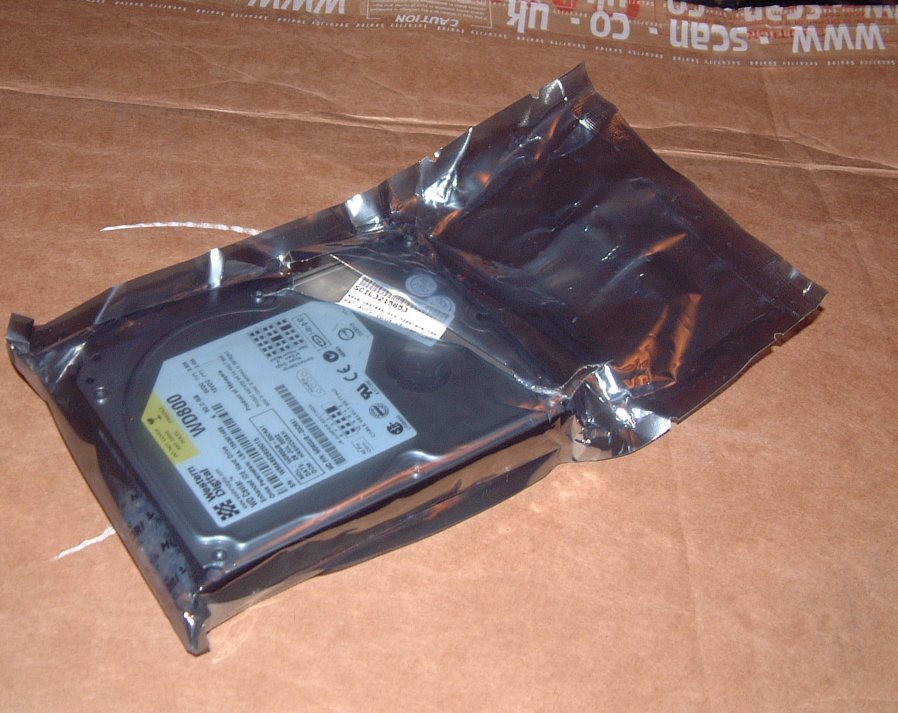
Straight out of the box from Scan, having discarded the acres of bubblewrap.
"Hold on a moment... that antistatic bag has been opened... That's not proper" flashed through my mind, along with "is this a reconditioned drive? Have I been given a drive that someone else has returned for some reason?"
At this point, a little aside:
Antistatic bags of this type are a layer of aluminium foil enclosed by plastic.
Their purpose is to create a Faraday shield around the device you're protecting.
The effect is that it is practically impossible to create an electrical
potential difference of significant magnitude across the hard drive while it is
in the bag.

Now consider the bag is not intact. Further, consider that part of the hard
drive is in contact with the acres of bubble wrap surrounding the drive.  Bubble
wrap is not conductive, and there's no reason why a static potential of around
20kV might not exist on the bubblewrap. My opening the package, and pulling back
the packing tape from the bubblewrap would certainly have generated an
appreciable voltage - even wearing an antistatic wriststrap, and on a conductive
mat. Since the hard drive is no longer fully protected by the bag, who's to tell
what voltage it has experienced.

What's more, exposure to high voltages doesn't always cause an immediately
failure of a device, it might just have shortened the life of my hard drive by
20,000 hours.

Then again it might not have caused any damage at all. Once a device has been
exposed to the risk, the only way to analyse the damage (if there are no overt
signs of it) is to take the semiconductors out of their plastic packages, and
take a very close look (close like scanning electron micrography).

See http://www.wallash.com/datastorage.pdf if you're interested in more detail.

(I'm an electronic engineer with a Master's degree, understanding ESD is part of
my job.)
A closer look, and I discover why the bag has been opened. I am supposing that Scan had decided that they wanted to affix a label to my hard drive with an identification number. Why they couldn't just have read the serial number of the drive through the bag, I don't know.
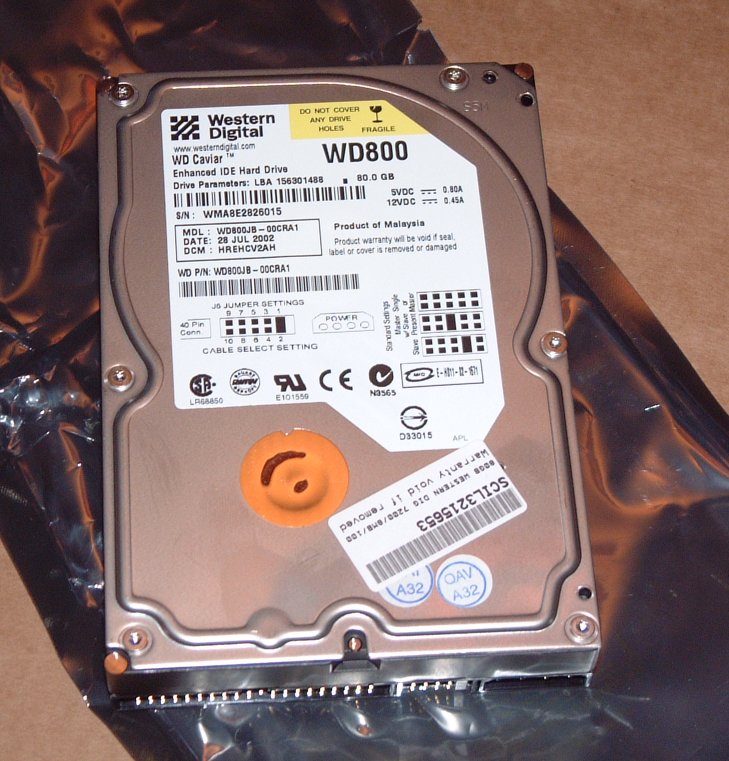
What's that bit of Writing in the yellow patch at the top of the drive? "DO NOT COVER ANY DRIVE HOLES" well, ok, I'll try to remember that. It seems fairly simple.
What's that just peeking out from under Scan's SCIL label? Let's take a closer look:
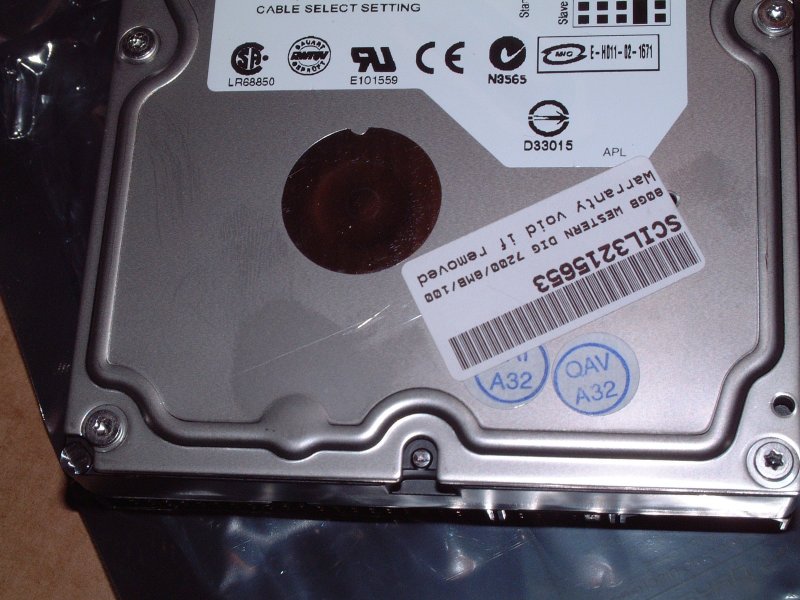
Oh... its a hole. Isn't that the breather hole for the hard drive? What did that Yellow thing say again...? That was the hole that the yellow warning was desgined to protect wasn't it? Does that invalidate the drive warranty? How about if I peel back the label - interfering with Scan's ID label is probably sufficient cause for them to refuse to honour my warranty... In the words of Bart, "Well, you're damned if you do, and you're damned if you don't." .
What's that catching the light just left of the label? Looks like a scratch... Like perhaps from someone opening the antistatic bag with a knife, and not being careful about what they're doing. Oh, that's right, the bag was already open, wasn't it... lets go back to the first picture. Yes, that looks like the scratch is right where the bag had been opened. Lets have another look at that sticker position... right on top of the scratch.
Well, that seems fairly conclusive to me. What do you think?
Addendum 04/09/2002
Seagate have a fairly good (and not very confusing) proper handling guide on their website.
http://www.seagate.com/training/properhandling/munitintro.html
It introduces the concepts of mechanical damage to disk suface and bearings. It mentions ESD, but doesn't go into enough
depth on how the damage occurs, and what damage is caused (imho, but remember I'm an electronics geek)
However, I was delighted by these statements:
- [ESD page 5] "Never insert a metal tool or knife into the bag and rip it open."
- [ESD page 6] "Keep your drive in the ESD bag until you need to handle it."
- [Packing/shipping page 3] "do NOT use... bubble wrap... as packing."
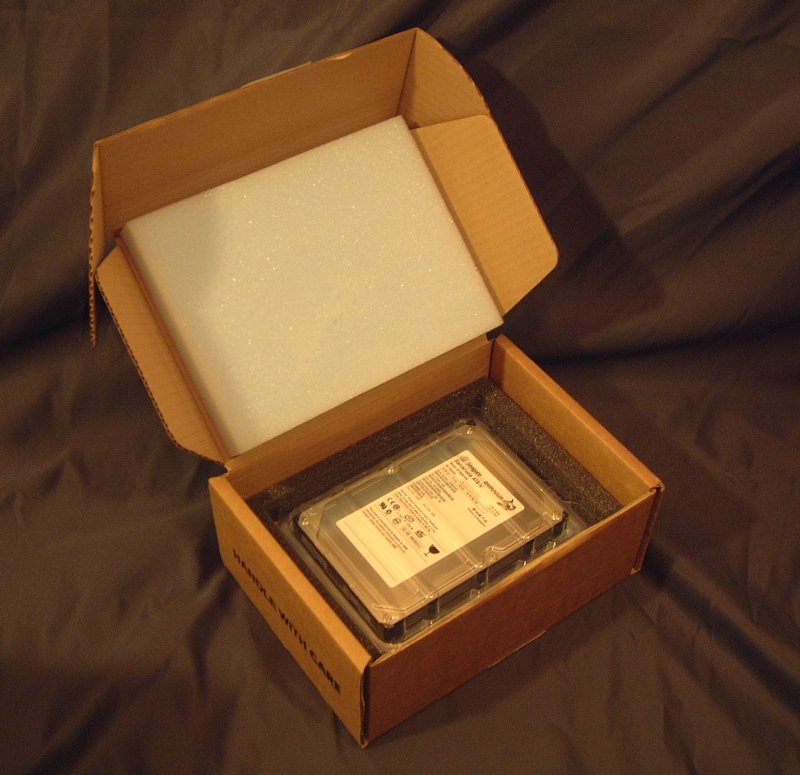
Indicentally, I bought a Seagate drive recently. I was so impressed with the drive packaging, I thought it was worthy of a little section here. The drive came in a reasonable sized cardboard box, which contained 3 layers (under, over and around the hard drive) of foam rubber. Nestled in the cavity in the middle layer, the hard drive is enclosed in a 'Seashell', which is an antistatic plastic clamshell affair. This Seashell has ridges that act as an additional shock absorber, and is in my opinion the best way to ship a hard drive.
And now I've found a similar document on the Western Dig site:
http://www.wdc.com/library/dhg.pdf
I feel that Scan should note:
[page 9]"Western Digital hard drives have one to four small air filter holes on either the top or side of the drive
 enclosure.  Do not obstruct or cover these holes with items such as stickers".
Interestingly enough, there are some figures for G forces generated by dropping a hard drive from selected heights onto selected surfaces. The figures state that dropping a hard drive from half an inch onto a hard surface, such as a concrete floor or a table top will generate around 200Gs, which is typically the limit of hard drives' shock spec when they are not operating.
[31/10/2002] The cheeky bar-stewards have done it again.
Having emailed them about their previous hard drive vandalism, I felt sure that a respectable vendor would ensure such a thing would never happen again. After all, the customer is always right, and a vendor's reputation is paramount, isn't it. So I ordered some more stuff from them.
More fool me.
Maxtor 40GB 7200 RPM drive. Again, was supplied wrapped in acres of bubble wrap, which I believe is foolish. And inside the
bubblewrap, a torn antistatic bag (that's right, the bubblewrap was in contact with the hard drive, so the anti-static bag
was not forming a faraday shield, and was therefore pretty much useless (remember these antistatic bags are a conductive buried
film, they're completely different to the dissipative antistatic bags)), and another dirty big scratch across the hard drive.


But, credit wher credit is due, I also ordered some SDRAM from scan, and was mightily impressed that they've now got antistatic carriers to ship the RAM in. This seems a lot better than just bunging it into and antistatic bag. I like them. Picture coming soon.
This page has been created by, and is maintained by Paul Norton.
All content is Copyright Paul Norton 2002/2003 unless otherwise stated.
Comments, questions, notices etc should be sent to:
luap@icculus.org
(Timezone: America/New York)